
This is where I fight to end war, poverty and oppression.— Robert Steele

Another Problem Worth Solving
How to clear 15,000,000 acres of farmland from landmines in under 12 months, for a profit.
Somewhere tonight, a kid is walking home from school in a country whose war ended before he was born. He knows the path. Everybody knows the path. And one day he takes a shortcut — one step off the trail, one wrong patch of dirt — and that old war reaches up out of the ground and takes his legs. Seven kids a day, every day, from wars that have been over for decades.
You already know I like to solve problems. This is another one, and it was bugging me: how do you get millions of landmines out of the ground cheap enough and safe enough that a poor country could actually do it? I chewed on it the same way I chew on everything — until it gave up. This is what I built: a landmine-clearing machine so simple, so cheap, and so stubborn that a crew of farmhands can put it together from rebar, concrete, and steel tubing, and it will crawl across a minefield eating mines all day and ask for more. Patent pending. It clears better than 99% of the mines it runs over. When a big anti-tank mine goes off under it and does real damage, you patch it with a grinder and some cement, take a 30-minute break, and you’re back to work after lunch. I designed it so the poorest country on Earth could build a fleet of them cheaply. On purpose.
I think this could help damn near everybody. All we have to do is build it.
I want the United States Marine Corps to build the first ones. Marine combat engineers, on camera, building a mine-eating machine out of hardware-store steel — then blowing it up, finding what breaks, fixing it, and blowing it up again until it shrugs. Then we post the whole build on YouTube, free, forever, so any government on Earth can make its own.
Why the Marines? Because it’s the most Marine thing imaginable: we clean up our own trash — ours, and everybody else’s, from every war anybody left lying around. The Corps gets the win it deserves in front of the whole world, doing what Marines actually do: take what’s on hand and get it done. And an old, bad Marine gets to watch his garage project graduate boot camp. A couple of Marines with cement, rebar, and explosives to test it with could give somewhere between 1,500 and 2,500 kids a year their legs and lives back — this year and every year after. That’s a hell of a Toys for Tots.
Fifteen million acres of the world’s farmland is locked behind landmines. That land has been resting for thirty years — it needs no nitrogen fertilizer for the first two crop cycles, and with Middle East petroleum running short and fertilizer prices about to spike, that rested ground is the cheapest, richest dirt on the planet. We don’t run this like a charity with its hand out. We run it like a business with its head up: Americans finance the micro-loans that clear the land at a guaranteed 5% return, the local bank lends it to the farmer at 7% for clearing, seed, and planting, and the land itself pays the loan back over a couple of harvests. I priced the whole thing assuming a third of the farmers won’t pay — three times the real-world failure rate — so the money comes back plus interest unless something drastic happens. Nobody begs. Everybody eats. And seven kids a day keep their legs.
No secrets on this one — the D-Miner works because everyone can see how it works. It’s a spiked roller sled pushed by any 100–150-horsepower farm tractor or bulldozer — or, if you want to be extra safe, an old military tank. Two booms carry three armored drums each — anti-tank, anti-personnel, and digging drums in series — each drum a set of concentric steel pipes packed with rebar, mesh, and concrete on a plain ball-bearing axle. At a suggested 5 mph — it can run up to 15 — the drums drive steel spikes into the dirt with over 600 pounds of force per spike — more than enough to trigger every pressure mine made — and because three drums run the same lane one behind another, what the first one misses, the second or third one eats. Three 90%-plus drums in series clears better than 99.9% of what’s in the ground.
When a mine goes off, it chews a patch of the drum’s sacrificial outer skin — rebar cage, sheet metal, rubber tire bands over a concrete core. An anti-personnel mine costs a dinner-plate patch; an anti-tank mine tears up a few feet of the outer layer and the core underneath shrugs. Repair is a grinder, a bag of cement, and an overnight cure — fifty to a hundred bucks — while a spare drum rotates in and the sled keeps eating. An eight-foot V-plow rake and shield rides in front of the tractor or bulldozer, combing the lane clean and keeping the machine and the driver safe from shrapnel. The whole thing bolts together with basic welding and hand tools — no specialized fabrication, no factory. A volunteer crew builds one for about $8,700, and it clears roughly 17 acres a day. It’s not high-tech. It’s un-killable low-tech, and now it’s public — so no defense contractor can ever patent it out from under the people who need it.
No secrets here either. Rebar, concrete, standard steel pipe, and a Sono-tube mold. No factory, no special parts — and it’s built to survive the mine going off under it.
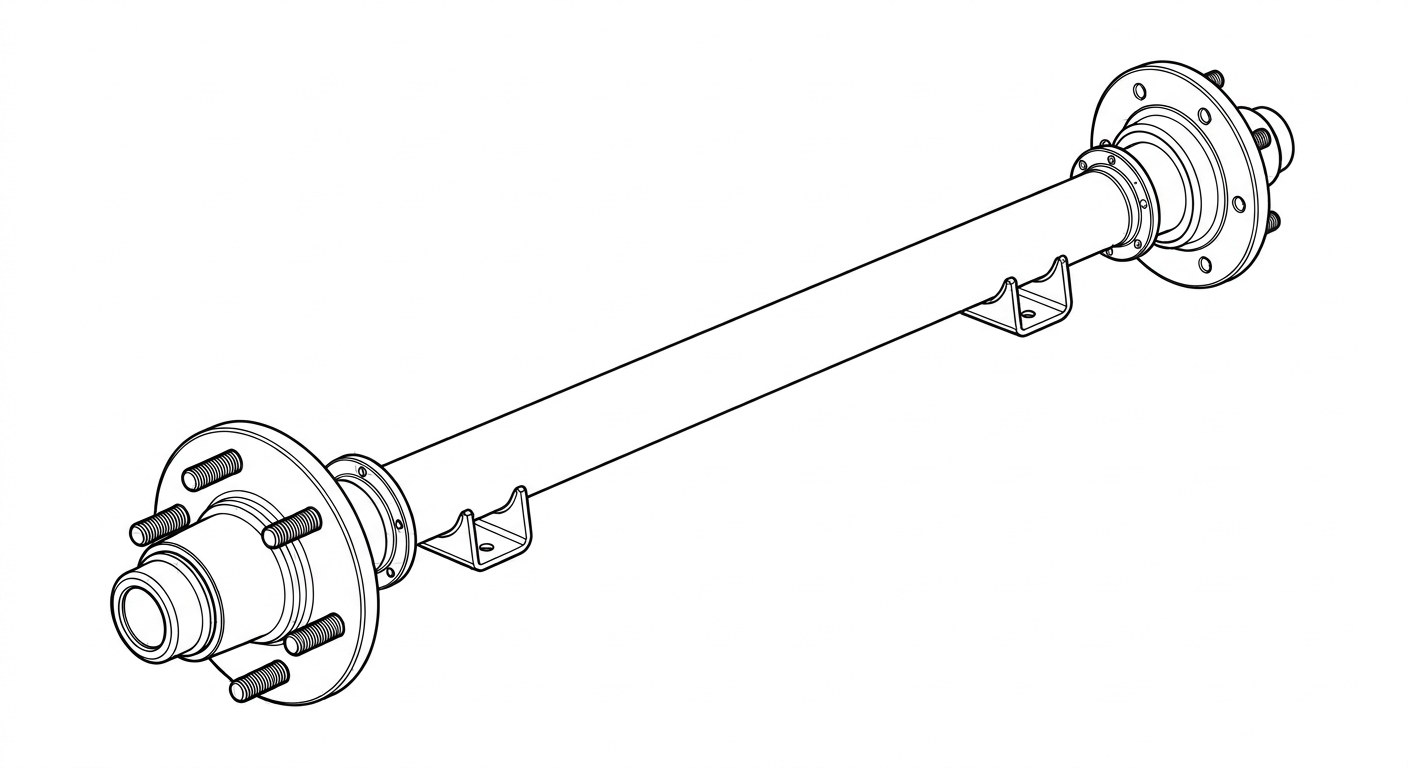
THE DRUMS RIDE ON TWO SUPPORT BEAMS THAT MOVE UP AND DOWN ON THEIR OWN
The drums don’t hang off one rigid axle. They mount on two beams that raise and lower independently, each on an anchor hinge. When a drum runs over a big mine, that hinge lets the arm kick up and back instead of taking the full shock head-on. Most anti-tank mines go off the instant the first drum touches them — and when they do, the support arm uses the weight of the other drums as a counterweight against the blast, so the whole rig rides it out instead of getting thrown.
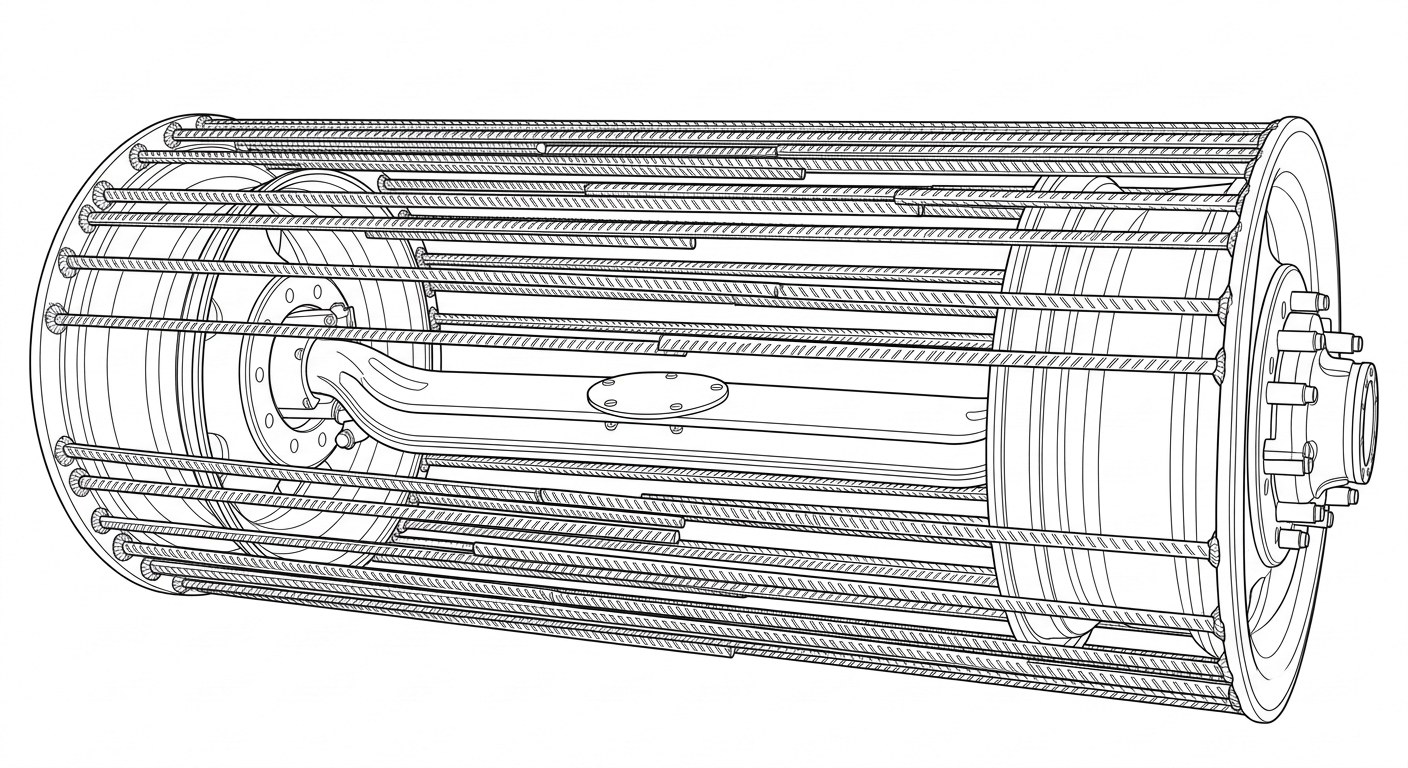
REBAR LAID ONTO THE RIMS TO FORM THE CAGE
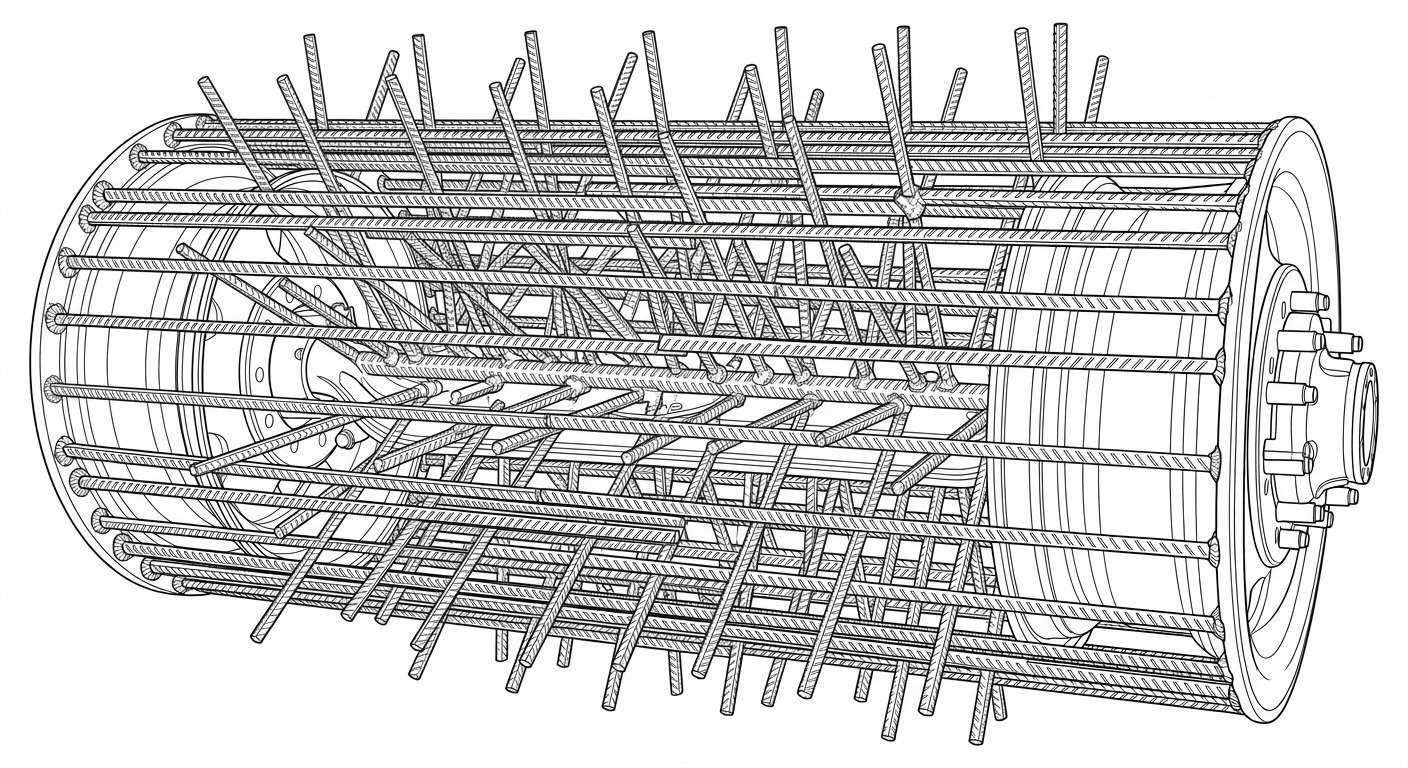
THE FINISHED CAGE, SPIKES ON, BEFORE ANY CONCRETE GOES IN
You start with the cage — rebar built out on the rims, with the spikes worked in. One thing the drawings get wrong: the spikes are shown pointing straight out, but they’re supposed to sit at a 30-to-40-degree angle. That angle lets a spike stab the ground head-on as the drum turns, driving straight in, instead of raking down into it on a weak downward swipe. Head-on is what sets a pressure mine off.
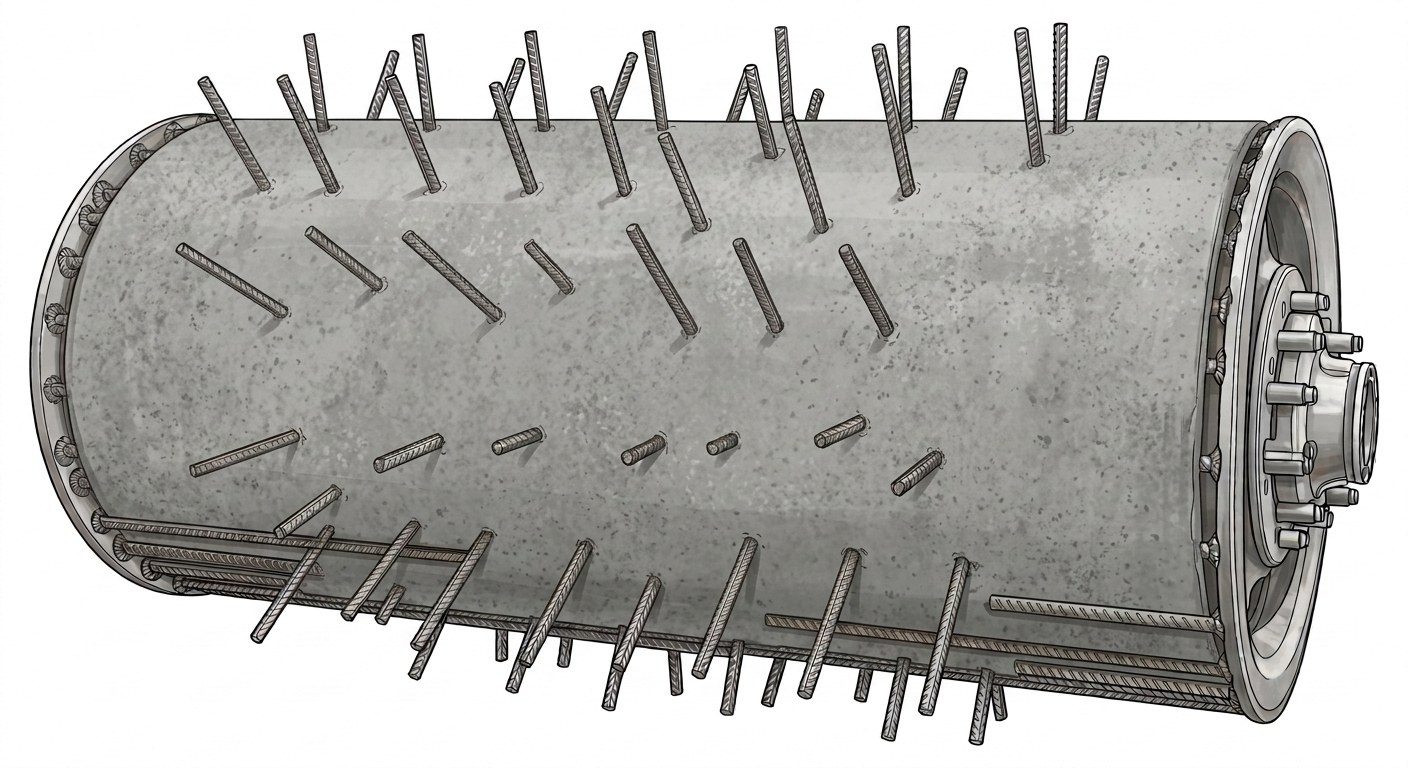
CONCRETE PACKED AROUND THE CAGE — NOTE THE ROUNDED BODY
Then the concrete goes in around the cage. Two things to notice. The drums are shorter than they look in these drawings. And the body is rounded on purpose — a round drum lets the force of an explosion slip around it and escape, instead of catching the full blast flat and taking all of it. The drum doesn’t try to stop the explosion. It lets it go by.
The support arms are the part that has to live through the blast, and they’re built in layers. Start with steel tubing nested inside itself — 1-inch, 2-inch, 3-inch and 4-inch, all with quarter-inch walls. Between the layers you inject cement mixed with chopped-up chicken wire, which locks the whole stack into one single beam that’s far stronger than any one pipe. Then that beam gets wrapped in a Sono-tube packed with cement and chicken wire. That outer casing is the sacrificial part — it’s there to take the shrapnel and debris hits. When it gets chewed up, you patch it with plain cement and chicken wire and keep going, and the steel core underneath never gets touched.
The tractor or bulldozer pushes the drums out ahead of it, so between the drums and the machine there’s a shield wall with a plowing rake built into the bottom of it — and it rides in front of the tractor, not behind. The rake combs the debris the drums kick up out of the ground. The wall does two jobs: it protects the machine and the driver, and it’s built tall enough that the driver can see over it but a blast can’t reach him — anything that goes off gets thrown up and over the top instead of into the cab.
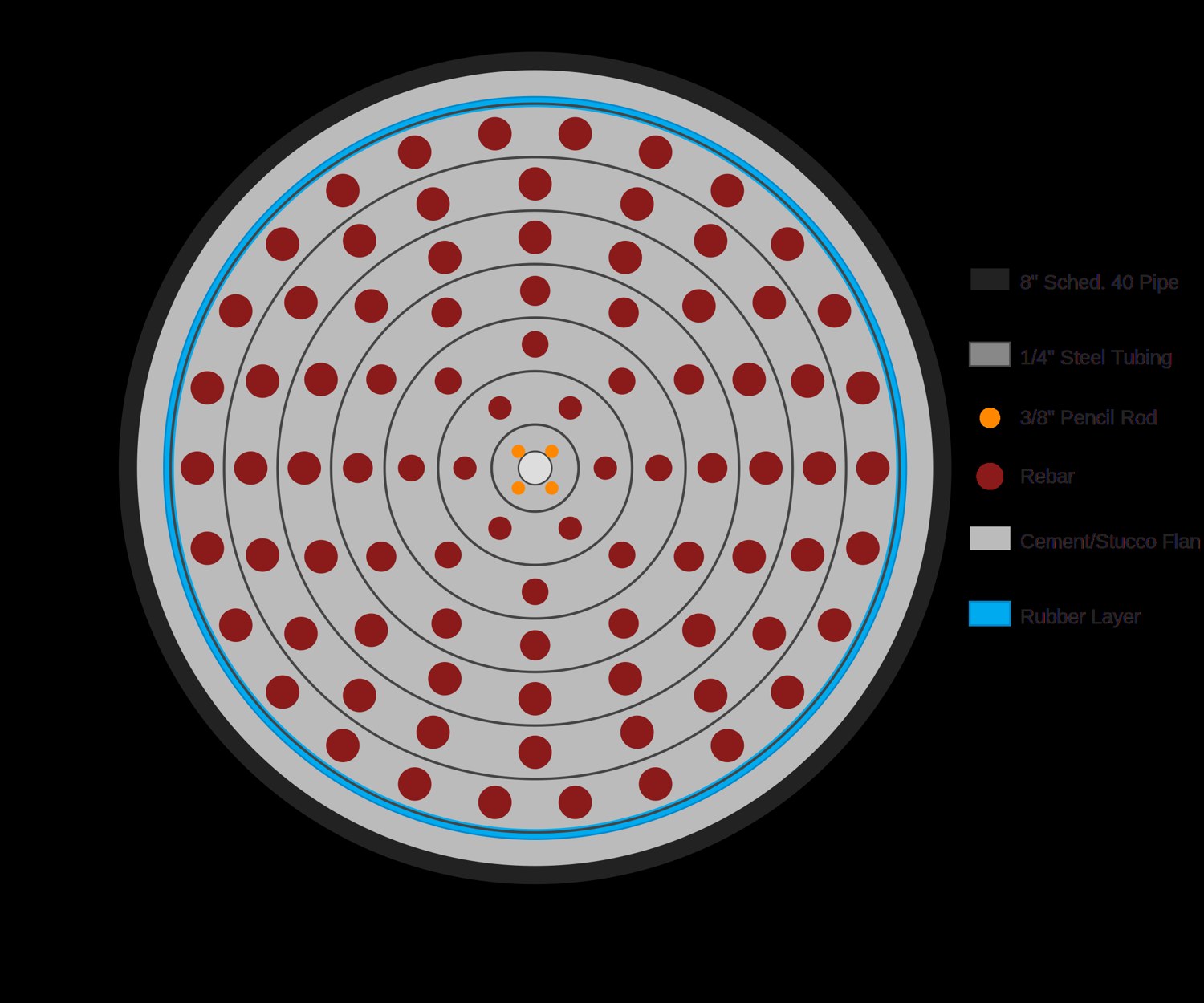
END-ON: PIPE, QUARTER-INCH STEEL TUBING, REBAR RING, AND CEMENT FILL INSIDE THE SONO-TUBE FORM
This is the drum looking straight down the middle. The rebar isn’t just for strength — it’s there to add weight, because weight is what drives the spikes down hard enough to trigger a mine. The whole thing is cast inside a Sono-tube construction form — the same cardboard tube used to pour concrete columns.
It doesn’t have to be perfect. Close is good enough — the roller still works fine if the mold is rough. Use whatever you’ve got to make the outer form. Another way: bolt together used tires with the sidewalls cut off, line the flat tread up into a ring, and pour the concrete inside that. When it’s done you just leave the tires on — that’s a little extra armor over the concrete for free.
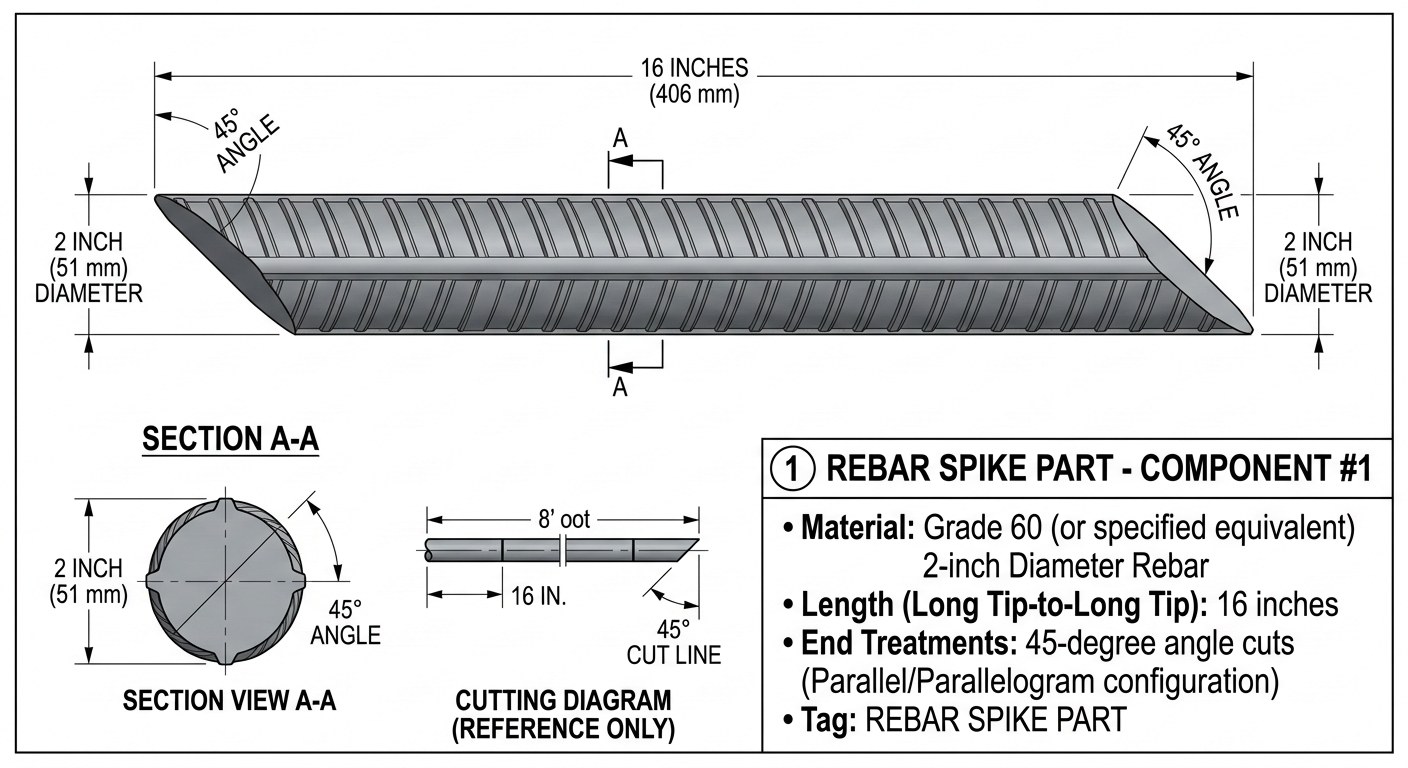
ONE SPIKE: 16 INCHES OF 2-INCH GRADE-60 REBAR, CUT AT 45 DEGREES
Every spike is a 16-inch length of 2-inch Grade-60 rebar with a 45-degree cut on the tip. Nothing exotic — rebar you can buy anywhere, cut on an angle, set into the cage at 30 to 40 degrees so it stabs straight into the dirt.
| Configuration | 2 booms, 3 drums each — anti-tank, anti-personnel, and digging drums in series |
| Drum length | 4 ft each |
| Drum outer diameter | 15.125 in (concentric steel-tube core) |
| Drum weight | ~1,290 lbs each — ~7,740 lbs for all six |
| Total drum width | 8 ft (2 booms × 4 ft drums) |
| Effective clearance lane | 7 ft (8 ft drum width, 1 ft overlap) |
| Operating speed | 5 mph suggested — can run up to 15 mph |
| Clearance rate | ~4.2 acres/hour at 5 mph · ~17 acres per 8-hour day (realistic field duty) |
| Boom arms | 16 ft CTA (Cement Tubing Armored) beams — nested 1–4 in steel tubing, ¼-in walls, cement-and-wire filled |
| Plowing rake | 8 ft wide, rides in front of the tractor — 1-in steel teeth, rebar leading edge, 45° V-plow & shrapnel shield |
| Total weight | ~11,800 lbs (5.9 tons) — ~7,740 lbs of drums plus ~4,060 lbs of frame, booms, rake and hitch |
| Tractor required | 100–150 HP, Category III 3-point hitch (or bulldozer / surplus tank) |
| Total build cost | ~$8,700 — rebar, concrete, standard steel pipe, salvage parts |
How the coverage works: a 7 ft lane at 5 mph (26,400 ft/hr) covers about 184,800 sq ft an hour — roughly 4.2 acres. Over an 8-hour day, allowing for turns, drum swaps, refueling and the careful pace mine work demands (about half the clock actually cutting), that comes to roughly 17 acres a day. Run the machine up to 15 mph on lower-risk ground and the rate climbs with the speed.
War planted fifteen million acres of death. I intend to harvest it.
One more thing. This is the free one — the cheap, public, build-it-yourself version I plan on clearing the world’s minefields with, so any poor country can put a crew on it tomorrow. But I’ve also got a military-grade version that’s a whole lot tougher and runs by remote control, so nobody has to sit on the tractor at all while it clears a field. And here’s the part I’m proud of: even the military one stays field-fixable and dead simple — same cement, rebar and hand-tool repairs, easy to maintain, easy to break down and haul. It just comes with some pretty cool modifications on top. This page is about the one anybody can build.
If enough of you send this to the Marine Corps Warfighting Laboratory (mcwl_pao2@usmc.mil — send them an email →) and tell them you want them to build it, I bet they will. Forward the link to this page — let’s see how many people decide the Marines ought to do the right thing and clean up their messes. The full breakdown — the money, the math, the compost-tea side business that feeds the soil — lives over at uslove.org. Go dig.
— Robert Steele, USMC